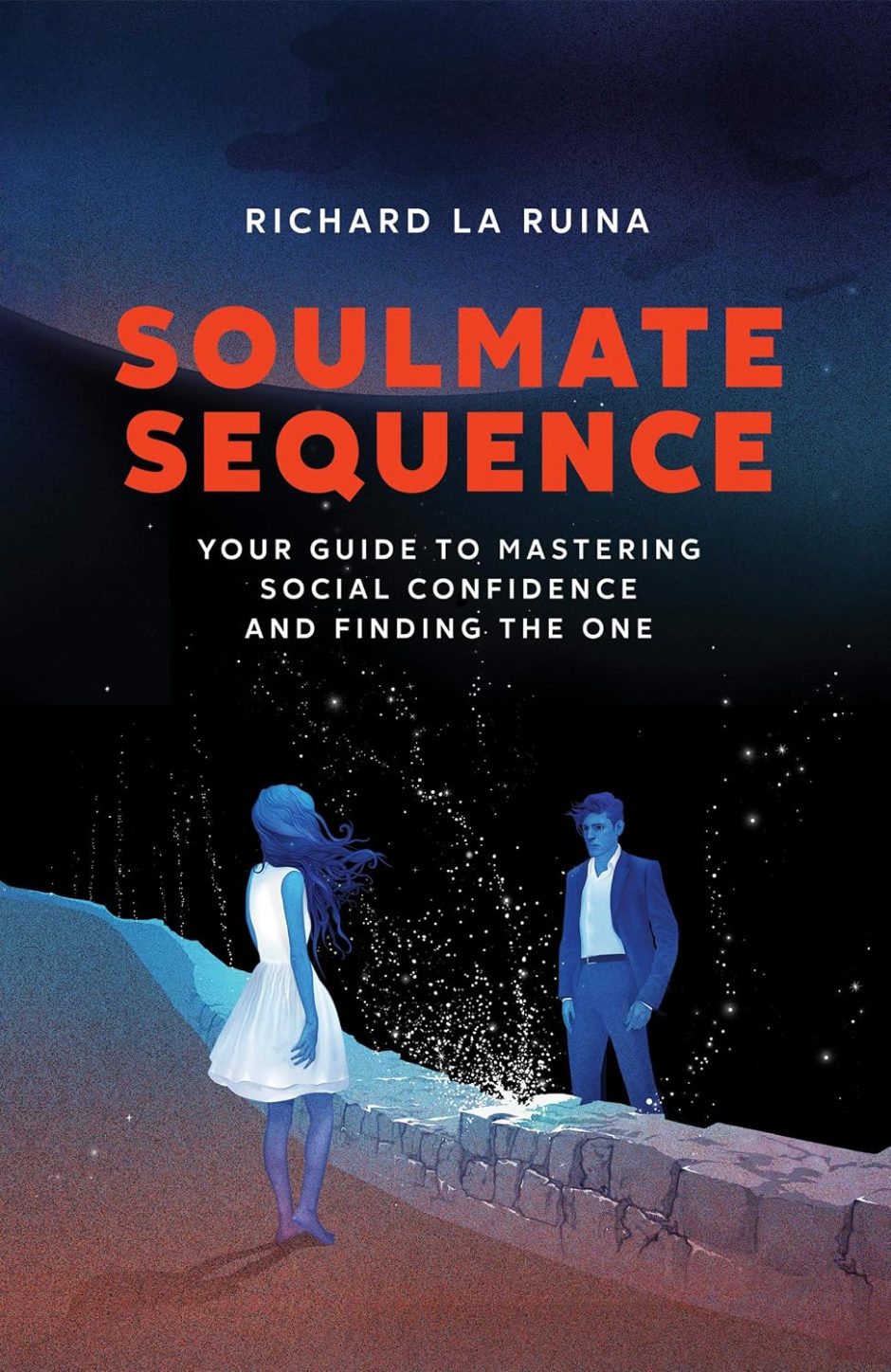
Soulmate Sequence aims to make you more sociable. Why?
Richard La Ruina argues that if the best things in life are behind a locked door, the key to unlocking that door is connecting with others.
In other words, take control of your social life, and a dream job, deep friendships, and a wonderful relationship become widely open for you.
But there’s a problem.
Not everyone is born like that co-worker everyone likes and agrees with or… that friend who goes to a party and comes out with contact details from half a dozen new people.
The good news?
For those of us who don’t have the natural ability to draw others to us like magnets…
Magnetism can be learned… and mastered.
And this book gives you the skills to participate and build fulfilling connections instead of… sitting on the sidelines drinking soda.
Soulmate Sequence consists of four parts.
Mastering Magnetism
The first part lays the groundwork.
If you want to be good at meeting anyone and making them like you, this gives you a lot of skills for social interactions, conversation, and confidence.
The opening chapter talks about actively creating your social group.
The author dedicated two chapters to this topic. He even included a note for introverts.
Why is actively cultivating your social circle that important?
La Ruina argues that most people are held back by their friends who aspire to nothing.
Do you have friends like that?
Friends who act and think exactly like you and do not challenge you to grow?
Then the author very much wants you to examine your social circle with a logical eye and change your group if it holds you back.
It’s hard to change when those around you stay the same.
Don’t worry. You don’t have to toss out your old friends. But you need to at least make room for a more diverse social circle.
Or limit negative influences from your life.
The point is to be selective about who you spend time with because… having the right people around you can make all the difference.
“Who you spend time with is who you become. Proximity is power.”
—Tony Robbins
So surround yourself with people who you want to become, people who have the specific traits you desire.
For example, if you want to become better with women, it helps to spend time with charismatic men who are already skilled and successful with women.
Why the friend zone is a great place to be
The author argues that rather than rushing to turn an attractive stranger into your romantic partner, it is easier and more seductive to first have a friendly conversation, keep in touch, and then draw them into your social circle.
La Ruina provided several benefits for doing this:
- You get access to their social circle.
- You let a deeper and more relaxed connection build over time.
- And in case they’re unavailable, you still get to spend time and learn about them. La Ruina cites that high-quality people are always in demand and catching them single does not happen often.
The reasoning seems sound, but it’d be more convincing if the author provided a concrete example.
Bury the negative, foreground the positive
Are you phrasing your life in negative terms? Then you’ll find this invaluable.
The author suggests you rephrase negative statements and zoom in on the positive.
If you want to be more positive and make a better impression, it’s better to frame your instructions and observations in terms of what you want rather than what you’re avoiding.
Makes sense, right?
For example: “Don’t give up!” or “You can do it!”
Which would encourage you more?
Lead with statements instead of questions
Even when wrong, observations or guesses about her motivation, character, or feelings invite a much richer response than a rote sequence of questions like “What do you do?”
One of the most powerful ideas in the book is definitely using inviting statements formed from your observations about the other person and their world.
Alternate with deeper follow-up questions to draw out someone’s genuine passions rather than facts on their resume, and you’ve got a secret weapon.
When you first meet someone, you rarely get to talk about such stirring things. This gets someone you’ve just met to have the conversation they rarely have.
Paired with the active listening process, you can skip through robotized small talk to reach true, deep connections with anyone.
But that’s not all.
There are other conversational tools to help you master conversation, like a nonverbal cue to keep them elaborating, how to hunt for topics, how to avoid awkward silence, an empathy exercise, and how to become more interesting.
This next section is where it gets interesting.
When and how to talk about yourself
Don’t immediately relate everything back to yourself.
That’s a common mistake, La Ruina says. Why?
Because if you always bring the conversation back to yourself, you’re snatching the attention away from them. This deflates their enthusiasm to engage with you.
Plus, talking about yourself is far less interesting to the person you’re talking with. You engage people more when you center on their thoughts and stories. Remember?
Much better to stand there and just let them speak and wait until the conversation naturally turns your way. Once it does, La Ruina gives you a statement that contains several hooks. This allows your conversation partner to choose a thread they want to pull and doubles as a way to gauge their interest.
And if you have impressive facts about yourself you want to share?
La Ruina says to wait to be asked instead of bragging. Why? Because if you share that information without being asked, it lands poorly.
But the same fact, when specifically asked for, is likely to be welcomed and appreciated. Then deliver it in a low-key, deadpan way, rather than with obvious pride.
How do you become a confident speaker?
To become a confident speaker… you must master clarity and certainty.
According to the book, you need to communicate your thoughts concisely without filler words. You can sound like you’re stating facts using a flat or falling intonation at the end of your sentence.
The author explicitly recommends public speaking as a core practice method to build your confidence speaking to crowds. You’ll also learn to speak at the right pace, add gestures, and facial expressions.
And when you’re comfortable in front of crowds, you’ll find it easier to relax in a small group of strangers at a cocktail party. Naturally.
You’re also advised to find an actor you like, one who’s all-around attractive. Pay close attention to their movements and facial expressions. Then try to consciously model those actions.
Calibrate your smile, gestures, and touch
The book argues smiling has to be calibrated.
People who smile way too much appear less intelligent and less trustworthy, the book claims. And if you’re attracted to someone, smiling too much can make you seem insecure and try-hard.
It’s much better to reward someone with your smile when they say something you like. This way, people will work harder to earn your smile and value it more.
The author also argues that your smile should match your status. The general rule is: the higher your status, the less you should smile.
Smile only as much as your position warrants because people will take you more seriously if your smile means something. This advice is useful but not for everyone.
Here’s another useful and major skill to learn and practice for the typical introvert: gestures and touch.
Gestures and touch are important because they amplify your message and help draw attention to you. They make you more engaging.
If you’re as stiff as a board in conversations and you want to be a chilled guy whose gestures and touch flow naturally and freely, you need to start adding the occasional gesture for emphasis like a politician.
Ideally, you can find a friend to observe and… just copy.
How to fast-track intimacy
The book provides several subtle psychological tools to jump-start the feeling of being close:
- Create in-jokes: When you share a small experience with a friend and turn it into callback humor, you can speed dial a mutual memory.
- Use nicknames: Move from using the full name to a playful nickname used by her social circle to create intimacy with minimal effort.
- Use inclusive language: Use “we” and “us” early on to bring you closer together.
- Future pacing: Talk about things you will do together in the future, and you can make her visualize doing more with you and create memories before they even happen.
Become a social hub and make your friends happy
According to the book, when you design your own social group, your life can be filled with a diverse group of people who inspire you and open opportunities for you.
You can have lawyers, chefs, models, photographers, yoga teachers, or financial advisors who probably don’t know each other. You can help them out and put them in touch with others who need their expertise.
For example, you recommend your photographer buddy to those who need photo shoots.
Introducing friends with complementary needs to each other reinforces your own social position. You can be sure that whenever an opportunity comes up, you’ll be the friend they think of and help out.
Another way to do something for your friends is to get them to join you when you’re doing something fun.
Most people are open to adventures but are too passive to organize activities themselves.
By stepping up and taking on the work of booking group activities, you make it easier for everyone to have a good time since all they have to do is show up.
I favor this idea, but I’m one of those passive people.
What if you have a friend who usually answers ‘no’ to your invites?
How to persuade a reluctant friend into a house party
Inviting someone and hearing “no thanks” is not fun.
So what does La Ruina suggest you do? The author suggests making statements that naturally lead into your invitation, rather than asking direct questions that can be easily declined.
This lets you avoid getting the reflexive ‘no!’ and you’re much more likely to get a ‘yes!’
He also adds another tool that dials up the chances of getting a ‘yes’: the illusory choice.
Offer two choices that both lead toward what you want, so the other person feels they’re making the decision, but you’re still guiding the main outcome.
They have control over the minor details while you secure the core commitment.
The author calls these tactics persuasion, but this is a standard compliance technique sometimes called the illusion of alternatives.
Finding the One
After mastering magnetism, the second part turns toward romance.
Since you’re able to draw other people into your orbit, you are now poised to meet “the one” – your romantic soulmate. So this part focuses on the specifics that will help you succeed in dating.
It guides you on how to flirt, how to have great dates, when to get physical, and even how not to blow it by sending stupid messages between meetings.
It begins with an exercise.
Determining what you are looking for
The author argues that… before it’s too late to think through the relationship logically, you must ask yourself what you are looking for in a soulmate.
Sit down and list the virtues you need to find out about her. These are the qualities that are essential to you, not what she looks like.
Having a list of qualities you want in a soulmate helps you in several ways:
- It keeps you from falling for someone just because you’re lonely or some other fleeting emotion.
- It protects you from getting involved with the wrong person for the wrong reasons.
- It even makes you more attractive to others, because you appear thoughtful and selective, rather than overly eager.
Of course, you can also use this list when choosing your friends.
The author also claims that romantic opportunities tend to arise indirectly from being very sociable, rather than from actively seeking out a specific person.
Minimizing the casualties in casual relationships
This section focuses on handling casual relationships in an ethical way — or at least in a way the author frames as minimizing harm to the other person.
If you are not looking for “the one”, if you’re not sure if you’re ready… but you like her and want to date her but not long term…
Or if you find yourself in relationships that aren’t quite right…
The author advises setting clear expectations early and avoiding sharing deep personal details to prevent the other person from falling in love with an idealized version of you.
You also get some ways to let them down gently and other skills to prevent unnecessary pain.
How to have great first dates
Once you’re meeting great women, you don’t want to leave the success of your first date to pure chance. Right?
The author provides several suggestions for effective fun first dates.
One is choosing unique activities so you share something memorable and different. That way, the positive emotions from the experience become associated with you.
And as a bonus, sometimes, simply offering a more intriguing date idea than usual can make a woman more interested in going out with you.
The author even explains why you should invite her to a group date. One reason is that it gives you a subtle chance to see who she chooses to hang out with.
And if you’re not sure if the whole thing will go well, the book provides you with an easy way out. That way, if the date goes badly, you can gracefully leave; and if it’s going well, you can leave her wanting more.
The author also explains that for a date to be successful, it needs to progress through three specific phases.
It starts with getting over your initial discomfort together, then moves to connecting and finding reasons to like each other.
Finally, the third phase is about ensuring she feels a spark while also introducing sexual tension. This is…
The secret seduction sauce
Or how to be seductive and attractive in any situation.
This section is probably what you’ve been waiting for if women call you “sweet” and promptly relegate you to the friend zone for life.
It identifies the dumb things men do that push them into the friend zone and the five behaviors that bridge the gap between friend and lover.
The first is displaying genuine high value by having a lot going on and being a challenge.
The next is showing full confidence in yourself, your opinions, and beliefs.
The author encourages engaging in potentially divisive topics like politics and religion early to see if you share important values or views with her. And, in case things become heated, you’ll know some de-escalation techniques.
The third is letting her know you have standards. That’s why you have your list of lasting qualities your ideal partner should have. You use it to screen and probe your dates.
Next, you have to create moments of physical intimacy using non-verbal tactics to flirt and be playful.
Revealing your sexual side gradually
If you want to move from being just a friend to a romantic partner, the author suggests gradually revealing hints of your sexual side.
You’ll learn a couple of ways to do this as well as… when and how to get physical.
“To seduce and to be seductive you must learn to create sexual tension.”
According to the author, showing your sexuality is vital for a man.
So go ahead and go for the kiss on the first date, invite her to your place for some flix, and handle rejections like a gentleman.
If you’re like most men, you probably struggle with going for the kiss moment. You’re either afraid to get rejected or can’t figure out how to do it.
No worries.
The author offers strategies to use right before going for the kiss. And lets you know that you’re expected to push.
So, if the signal is go, push you must, as things will fizzle out if you fail to make a move.
At this point, you are now fully equipped to meet people, have great dates, and turn things sexual. What’s next?
Online dating and texting
The author much prefers meeting people in real life, but also acknowledges that digital dating and texting can be a useful supplement to good in-person social strategies.
For texting, he advocates for one very simple approach that works well for men and women alike: the “less is more” method.
The author points out that it’s extremely difficult to use texting to deepen a new relationship between dates. But it’s easy to let your visible online photos and profiles win affection for you.
Just be sure your online persona transmits the character you want to convey to a potential date.
How your social circle makes you more attractive
Here’s something interesting:
The book claims that the more bad dating experiences a woman has had, the more likely she is to have a healthy suspicion about you.
She may think that you seem “too good to be true.”
If you want to eradicate her doubts, let your social circle vouch for you; after all, the friends you keep reflect your character. So having a strong, positive social circle can help seal a great impression.
When she sees you surrounded by a warm, lively group of great people, it speaks volumes about your character.
As long as the friends you surround yourself with don’t make you look bad or embarrass you, of course.
Living Happily Ever After
Part three prepares you for when you’re in a happy relationship that you want to keep healthy and strong over the long term.
This part opens with the full story of the author meeting his wife Kate and… a disclaimer?
At the time of writing, the author had only been married for about two years.
This is a pretty thin foundation. It might be too soon for him to give advice about lasting happiness based on his own short marriage as a case study.
Anyway, the book lays out…
The reasons why relationships fail
The choices you make early on set the stage for long-term happiness.
That is why, if you have a subconscious pattern of choosing “toxic” individuals, La Ruina insists that you use your logical “virtue list” to resist these types.
The author also warns against staying with someone just because you enjoy regular sex or constant company, instead of truly valuing who they are as a person.
If your partner doesn’t match what you’re looking for, don’t make it last long.
And, of course, if you get complacent and let your attractive behavior erode over time, your relationship will eventually fail as well.
Take it fast, then take it slow
La Ruina points out that most couples move slowly at the early stages, but then rush the serious stages of the relationship. But when you do it like that, it’s hard to spot potential flaws you might face in the future.
What’s more, you end up stretching out a relationship like this, only to realize months or even years later that it wasn’t right for you and you’ve wasted time.
The author suggests moving fast at first to test the relationship. Then, if the relationship has legs, to take things slowly and deliberately with major commitment decisions like moving in together, marriage, or having children.
How to encourage better behavior
La Ruina compares dealing with bad and good behavior in relationships to training a squirming puppy or guiding little children.
He suggests using house rules and a process as simple as rewards and punishments to encourage better behavior.
Unless you’re a fan of B.F. Skinner and operant conditioning, you might see this as a red flag or at least something that raises eyebrows, since it treats relationships more like dog training than mutual understanding between adults.
Sometimes, even though he talks about empathy and integrity, La Ruina treats relationships less as equal partnerships and more like systems to manage and optimize for certain results.
Strategies for fighting fairly
Do you try to outdo each other by saying harsher things in louder voices until you’re both red in the face and screaming?
Next time that happens, the author suggests calling for a time out.
Agree ahead of time to take a break for five minutes; then return and talk calmly once you’ve both had a chance to cool down and think clearly.
This is especially the case for resolving contentious issues. Talk about major issues like money, jealousy, and lifestyle when you’re both calm rather than avoiding or letting it build.
The author also warns about reaching the point of no return — the moment when you start to see your partner’s character as permanently bad.
Once that happens, it’s very hard to save the relationship.
This part closes with a framework for…
Meeting the parents
Meeting her parents for the first time can be stressful.
You want to make a good impression. You want to be liked. For La Ruina, winning the approval of her parents appears to be very important.
He encourages you to reflect on and anticipate the specific qualities her parents will be looking for in you. He also offers some virtues that will help to win them over.
He wants you to be quiet and reserved when you’re in their home, present your relationship in the best possible light, and pay the ultimate compliment: explicitly praise the way they raised their child, highlighting the specific qualities you admire in your partner.
Using Your Social Skills in Other Areas
This part wasn’t actually introduced earlier in the book, so it feels a bit out of place.
After three sections on sociability, dating, and relationships, it suddenly shifts to a wider range of topics that don’t fully match the book’s main focus.
Anyway, part four applies your new magnetizing social techniques to networking, persuasion, gossip, disagreement, and humor.
Networking with high-status people
If you want to get to know high-status people, La Ruina suggests giving them value, rather than just looking for what you can get. Why?
Business leaders or celebrities are often busy. They are regularly approached by others who want money, deals, and advice.
They’re sick of that.
By providing something useful like a helpful business connection, you show that you’re not just a taker. This makes you stand out.
The author points out that it’s easy to connect with people who are just one level above you.
You can usually reach them by offering your own skills, knowledge, connections, or special access as something valuable to trade.
Why you should avoid gossip
The author takes a strong stance against gossip, calling it corrosive and destructive to group trust.
He advises that gossip should have no place among friends, and even listening to gossip can damage trust and your reputation.
Instead, only speak positively about others. Why?
Secondhand compliments heard through others are often more readily believed and appreciated. That way you build a reputation as a trusted confidant and a valued best friend.
Changing minds and handling disagreements
Opinions on important issues are often deeply rooted.
To change your friend’s mind, stay away from me-vs-you situations.
Instead, you must show you truly understand your friend’s perspective. Only after this should you lead them to your own way of thinking.
And to present a contrary view without creating friction, La Ruina advises never using the word “but,” as it negates everything said before it.
He further explains that he avoids coming across as preachy by never pushing his views on others about being vegetarian. Instead, he only responds when someone asks him directly, softens his claims, and often points people to documentaries rather than arguing his case.
By not pushing his views, people often become more curious about his position.
“Arousing curiosity is the first, best step to changing minds.”
How to be funny
If you want to be funnier, Richard La Ruina advises hanging out with a hilarious friend.
Observe how they see the world, and you’ll pick up their sense of humor, the way they deliver jokes and comedic timing, making it easier for you to be funny, too.
The book also covers the finer details of humor, takes a look at what makes people laugh, and breaks down self-deprecation, teasing, exaggeration, and ludicrousness.
These are just a few of the main ideas in Soulmate Sequence.
Closing Thoughts
As with Richard La Ruina’s previous books, much of the advice in Soulmate Sequence is based on the author’s life journey and observations from his coaching clientele.
So if you’ve read The Natural, you’ll be familiar, among other things, with the following…
- Being sociable and magnetic is something you can learn and develop with practice and the right strategies.
- You’re encouraged to create a specific list of virtues you want in your partner to maintain your standards.
- There’s a specific order to follow if you want to seduce your date.
- You’re instructed to default to statements over questions and to dig into feelings, motivations, and passions instead of boring factual exchanges.
- Emphasizes that body language and eye contact matter more than the specific words you say.
You can also expect practical, actionable advice, real-world examples, personal stories, and step-by-step techniques with missions at the end of each section to help you practice each concept in your life.
So they share the same core understanding of what draws people together and how effective interactions unfold.
While some of the terms may change, many of the core ideas and principles remain consistent.
But while some things remain consistent, Soulmate Sequence represents a different stage in Richard La Ruina’s personal evolution, reflecting his shift in perspective and goals.
Unlike his previous works, which focus on the mechanics of cold approaching beautiful women in clubs, this book focuses on becoming socially magnetic and finding long-term fulfillment in both relationships and life.
In short, this book is about building a stable, lasting marriage rather than chasing short-term conquests.
This marks a significant shift from using pickup tactics to a more holistic, empathy-driven approach to social intelligence.
Even the friend zone is reframed. Instead of seeing it as failure, the author suggests using it as an opportunity to build and expand your social circle.
Is that what happens when people settle down?
Anyway, Soulmate Sequence takes a broader view.
It focuses on general sociability and how these skills apply to non-romantic situations. You can even call it a general social-skills manual with a dating section.
In other words, despite its title, Soulmate Sequence is really more about developing strong social skills than about finding a soulmate.
The book also serves both audiences.
It includes advice for women as well. It often splits advice by sex within the same chapter, like in Chapter 5: how to approach for men; and how to be approached for women.
And, sometimes, directly addresses a woman’s specific concern.
Of course, the book has its flaws.
Treating a partner like a squirming puppy is essentially operant conditioning applied to adults. Its persuasion techniques verge on manipulation, and the book could use tighter editing.
On the whole, it’s encouraging to know you can systematically learn to be more social. That’s great for someone who naturally feels awkward around people. But this focus on optimizing can make relationships feel overly strategic.
Despite these issues, Soulmate Sequence is easy to recommend to thoughtful readers.
So if you are someone who wants a structured system for improving social skills and dating…
And you don’t dislike calculated approaches to social interactions…
La Ruina’s Soulmate Sequence can help you build strong social skills, become genuinely likable, find and keep “the one,” and enjoy lasting fulfillment in both your social life and relationships.
🛒Buy Soulmate Sequence on Amazon
Discover more from Attracting Women with Books
Subscribe to get the latest posts sent to your email.